
Quantum Breakthroughs and Nvidia GTC Highlights
This article covers the latest quantum computing breakthrough and key takeaways from Nvidia’s GTC event, along with their impact on the markets.

Before getting into the tech, let’s break down the latest FOMC meeting, as ultimately, the Fed’s policies shape the markets more than recent tech advancements. On Wednesday the Fed held rates steady at 4.25%-4.50%, citing persistent inflation concerns and economic uncertainty stemming from Trump’s new round of tariffs. While the Fed acknowledged that trade policies are adding inflationary pressure, it still sees a resilient economy, though it lowered GDP growth projections to 1.7% for the year and raised its inflation outlook to 2.7%. Markets took the decision in stride, with the S&P 500 rising 1.1% as investors found relief in the Fed’s cautious but measured approach. Looking ahead, the Fed signalled the potential for two rate cuts later this year, but Jerome Powell emphasised that any policy shifts will be entirely data-driven.
With that macro backdrop in mind, let’s turn to developments in quantum computing, where D-Wave Quantum continues to push forward in its efforts to commercialise quantum annealing technology.
D-Wave Quantum: The Specialist in Quantum Annealing
When most people think of quantum computing, they picture IBM or Google working on gate-based quantum systems capable of outperforming classical computers. Or they think of nothing. If you think of nothing, don’t worry I have you covered as I have already written about how quantum computing works. Either way, D-Wave Quantum takes a different approach.
D-Wave specialises in quantum annealing, a niche within quantum computing tailored for optimisation problems rather than universal computing. An optimisation problem, specifically in physics, is one where you try to solve for the lowest energy point possible. Instead of performing sequential logic operations like classical or gate-based quantum systems, annealers work by finding the lowest energy state in a complex system. This approach has direct applications in industries where classical computing struggles to find optimal solutions within a reasonable timeframe. For example, in logistics, quantum annealing is being used to solve complex routing problems where thousands of delivery trucks, warehouses, and suppliers need to be coordinated in real-time. Classical algorithms take too long to compute the best possible delivery routes when factoring in fuel costs, changing demand, and road congestion. D-Wave’s systems have already been tested by Volkswagen to optimise traffic flow in major cities, reduce congestion, and improve overall efficiency.
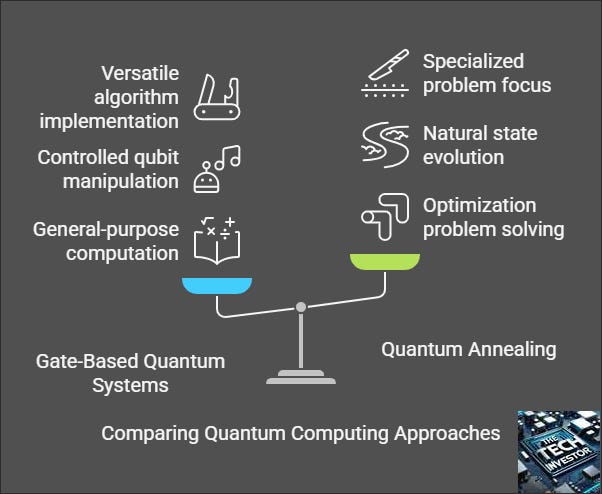
I won’t go into the details of exactly how quantum annealing works but there are plenty of videos online which explore it further if it’s of interest to you. You don’t need to be a physicist to come to a decision of whether to invest or not, but of course it does help. D-Wave has often been viewed as a second-tier player in the quantum race because its technology does not offer the same theoretical potential as universal quantum computers. However, that perception may be changing with its latest breakthrough.
In a recently published study, D-Wave successfully solved a large-scale optimisation problem significantly faster than classical computing methods. D-Wave has successfully simulated the behaviour of complex magnetic materials known as spin glasses. Spin glasses are a unique class of disordered magnetic systems where the orientation of individual magnetic spins is highly unpredictable due to competing interactions, preventing them from settling into a stable, uniform pattern.
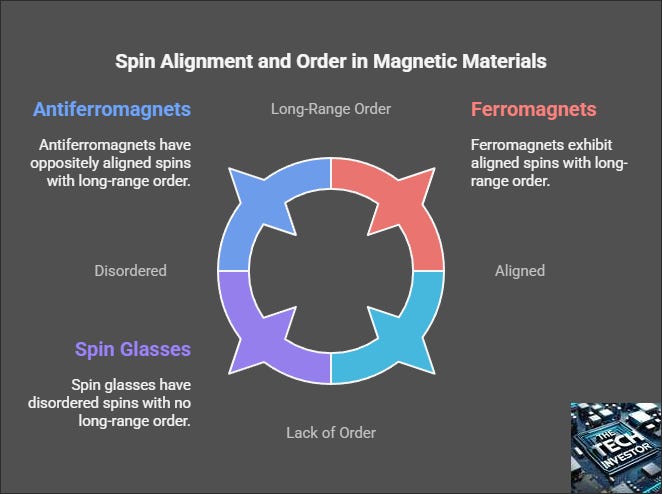
This randomness creates a complex energy landscape with countless possible configurations, making it incredibly difficult to model using classical computational methods. A key aspect of the study involved simulating quench dynamics which refers to how a system evolves when rapidly cooled from a high-energy disordered state to a lower-energy, more ordered state. In the case of spin glasses, this process is particularly complex because the system does not transition smoothly into a predictable structure but instead falls into a maze of nearly equivalent low-energy states. Understanding this evolution is critical for advancements in materials science and optimisation problems, yet classical supercomputers struggle to capture the full quantum effects governing the process.
D-Wave’s ability to simulate the quench dynamics of spin glasses is a breakthrough because it provides direct experimental evidence that quantum annealing can efficiently model complex real-world quantum systems. This has long been theorised but rarely demonstrated at this scale. Spin glasses are fundamental to understanding disordered systems in physics, but their chaotic energy landscapes and competing interactions make them nearly impossible for classical computers to simulate accurately. By successfully modelling how these systems evolve during rapid cooling, D-Wave has shown that quantum annealing can capture intricate quantum behaviours such as entanglement and non-equilibrium dynamics. These behaviours are essential for fields like materials science, cryptography, and machine learning. This validates the practical usefulness of quantum annealers beyond theoretical optimisation tasks and positions them as powerful tools for tackling complex problems in physics and beyond. It marks a step toward real-world quantum applications.
To be clear, despite the breakthrough, the applications still remain heavily academic. There is currently no way for D-Wave to commercialise this discovery, as of yet. Despite this, the headlines were enough to send the share price flying. Before I reveal the chart, I want to dive into D-Wave’s financials.
Financial Impact & Investor Sentiment
D-Wave has been a public company since the start of 2020 but was founded in 1999. It currently generates revenue by providing quantum computing hardware, cloud access, and professional services. Its primary offering is the Advantage Quantum Annealer, a system designed to tackle optimisation problems across industries such as finance, logistics, pharmaceuticals, and manufacturing. Customers can access this technology through direct hardware sales, cloud-based quantum computing via its Leap platform, and hybrid quantum-classical solutions. Additionaly, D-Wave generates revenue from research collaborations, consulting, and partnerships where enterprises integrate quantum computing into their operations. Despite growing interest in quantum solutions, the company has struggled to scale its revenue, highlighting the challenge of translating theoretical breakthroughs into widespread commercial adoption.
D-Wave’s latest financial results reveal a troubling disconnect between its revenue growth and escalating losses. Despite claims of commercial progress and technical breakthroughs, revenue for 2024 remained flat at $8.8 million, reflecting 0% growth YoY. Meanwhile, net losses widened from $82.7 million in 2023 to $143.9 million in 2024, a 74% YoY increase, raising concerns about the company’s ability to convert its quantum advancements into a viable business. The sharp rise in losses was largely due to a $68.3 million non-cash charge related to the revaluation of warrant liabilities, which significantly inflated the reported net loss. Warrants give investors the right to purchase shares at a predetermined price, and because they are classified as liabilities on the balance sheet, their value fluctuates based on the company’s stock price. When D-Wave’s stock price increased, the fair value of these warrants also rose, leading to a larger liability on the books and a corresponding non-cash expense in the income statement.
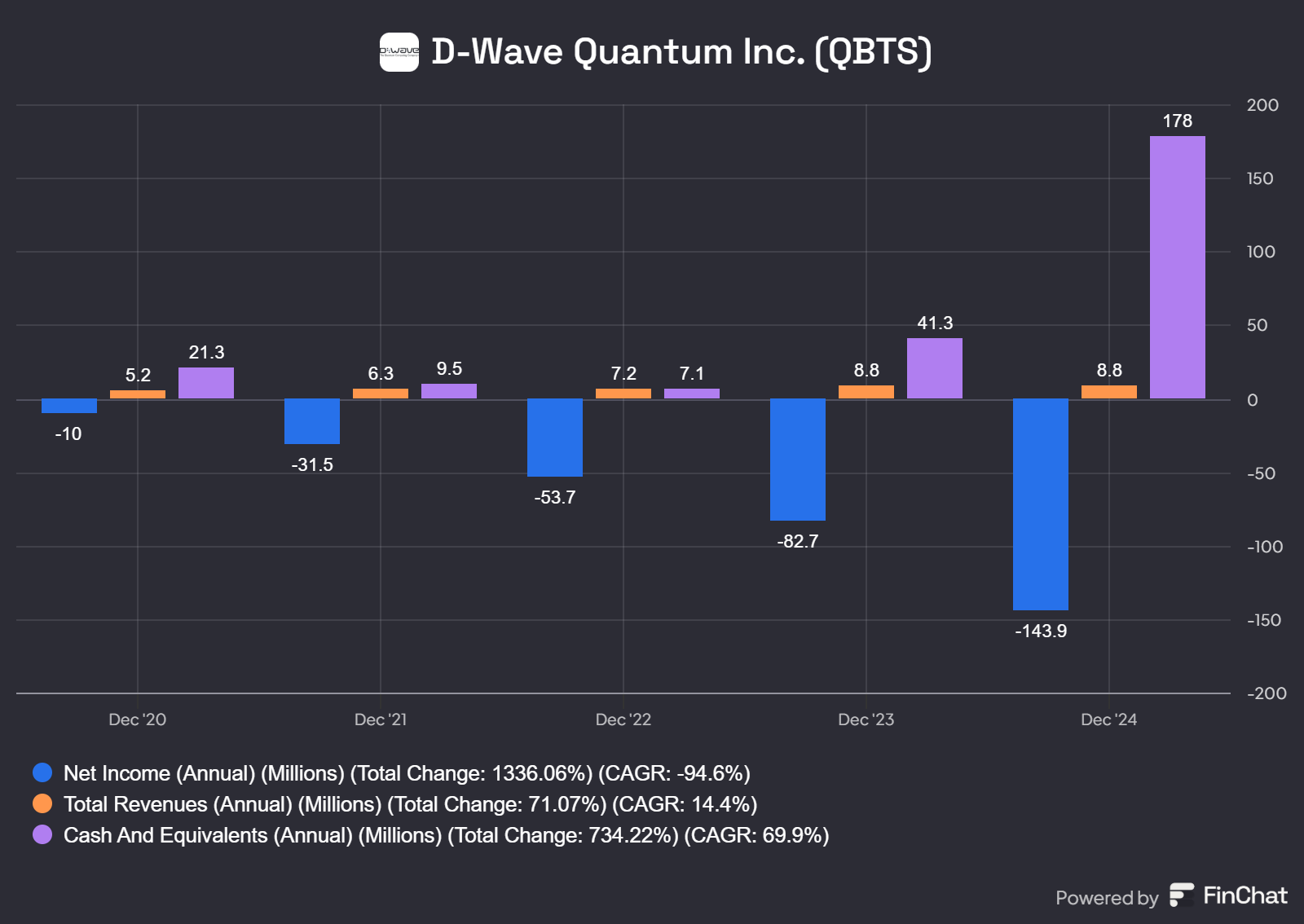
A positive (but also a double-edged sword) is that D-Wave’s cash position is significantly increasing. It has managed to raise money through equity rather than debt, meaning it does not owe money to lenders. However, this has come at the cost of shareholder dilution, as the company has issued a large number of new shares to raise capital.
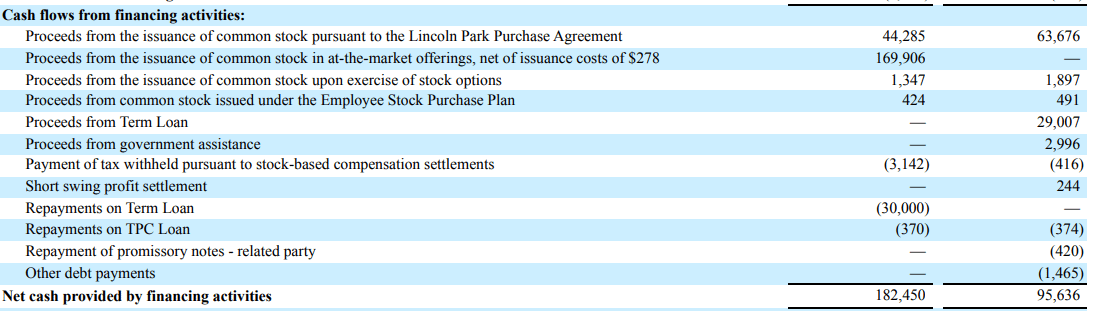
On the cash flow statement, there are two key line items that explain how D-Wave secured this funding. The first is "Proceeds from the issuance of common stock pursuant to the Lincoln Park Purchase Agreement" ($44.3 million in 2024), which represents the company’s Equity Line of Credit (ELOC). This arrangement allows D-Wave to sell shares to Lincoln Park Capital over time in exchange for funding, providing flexible access to cash while avoiding traditional debt financing. However, since these shares are often issued at a discount to market price, it can put downward pressure on the stock.
The second key item is "Proceeds from the issuance of common stock in at-the-market offerings" ($169.9 million in 2024), which refers to its At-The-Market (ATM) program. Unlike the ELOC, ATM offerings involve selling newly issued shares directly on the open market at prevailing prices. This allows D-Wave to raise money gradually rather than all at once, but still increases the total number of outstanding shares, diluting existing investors.
While raising over $300 million in cash strengthens the company’s balance sheet in the short term, it does not solve the underlying issue that revenue remains stagnant while losses continue to grow. If D-Wave cannot generate meaningful revenue growth, it may be forced to continue issuing shares, further diluting investors and putting long-term pressure on the stock.
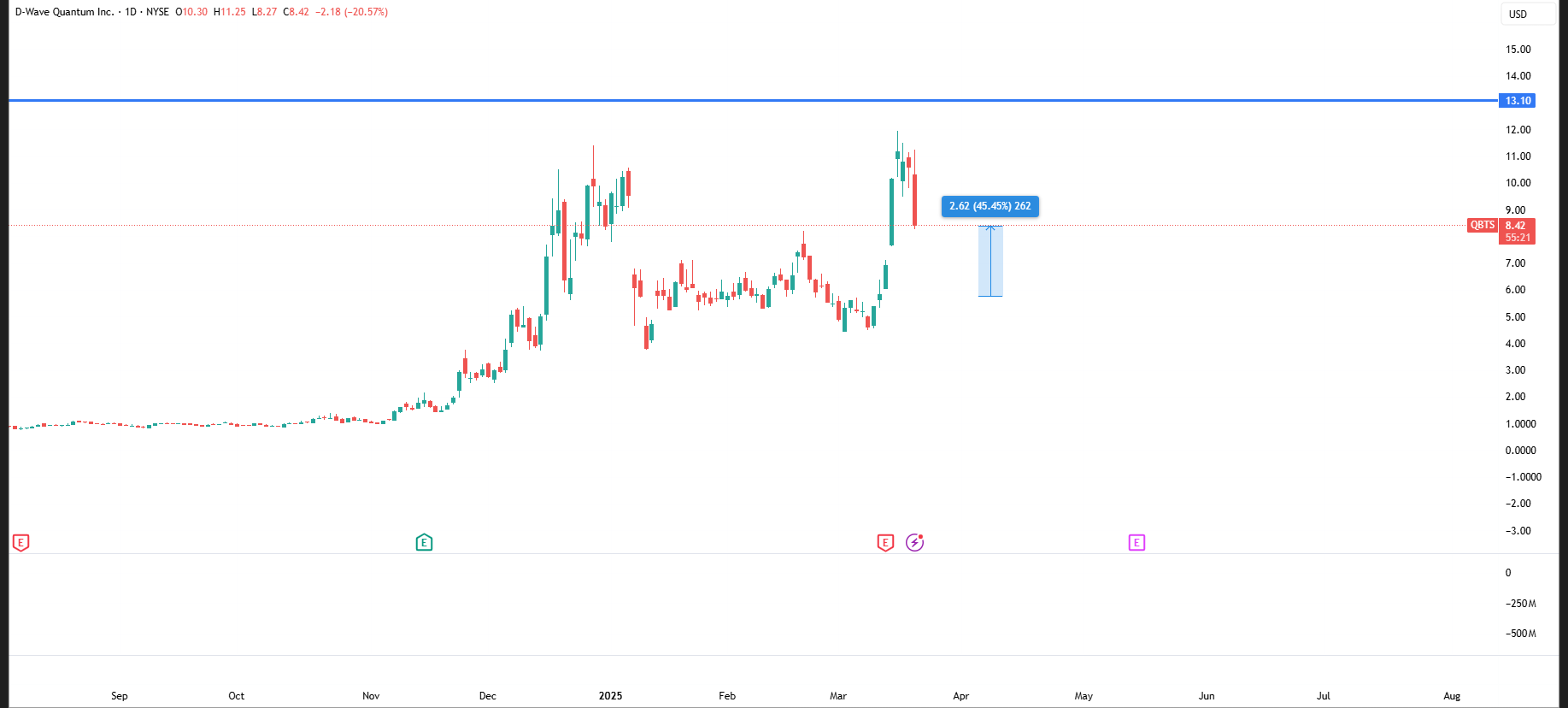
Now, let’s have a look at the chart and how investors are reacting to the latest breakthrough. The research paper was released on the 12th of March along with its Q4 earnings report. Price then surged ~85% and has retraced since but I’m pretty certain that this is a thin move and just a reaction to the headline. If you asked investors to break down what the latest breakthrough is, I’m certain 90% won’t be able to and I don’t expect them to, but I get the impression that this a move driven by hype and a lack of real understanding. I hate to say this as I’m extremely bullish on quantum computing and what D-Wave is doing is impressive but the further the stock rises, the more it looks like a short to me. A consistently unprofitable company with losses increasing yearly, trading at a price/book ratio of ~36 and a price/sales ratio of ~182 seems unsustainable and absurd to me. I suspect that there is heavy retail volume in this name so there is also the possibility of a short squeeze happening but one would have to monitor social media channel activity for this. I do hope I’m wrong as I’m a fan of what D-Wave are doing. I also would not try and time this short as any more hype will send shares flying past ATHs at ~13.10. My approach would be to use options rather than outright shorting the stock as that way timing the short doesn’t become as big of a headache. I think the current market environment we’re seeing of overvalued stocks being sold off could also boost returns on a short trade as more volatility comes into play over the next few months (which is my expectation). At Nvidia’s GTC event, Jensen Huang made another comment which sent quantum stocks flying lower. Following up on what he said in January about quantum computing being 10+ years away which sent quantum stocks into a meltdown, he said “My first reaction was, I didn’t know they were public. How can a quantum company be public?”. And guess what happened once he said that? D-Wave Closed down ~20%. This leads me to my next topic.
Nvidia GTC Key Points
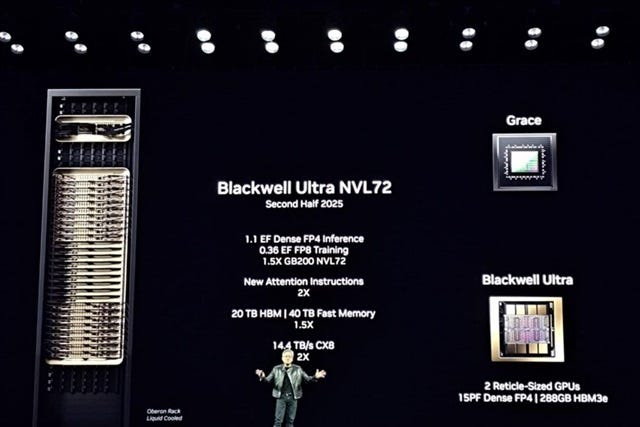
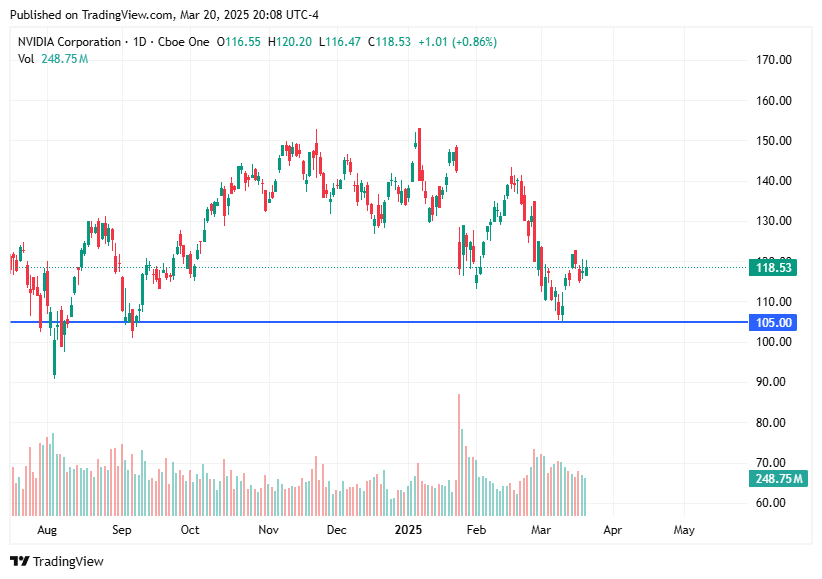
It’s fair to say that Nvidia’s shares have been strugglings year and have been at the centre of a tech sell-off. After going up in a straight for the past 2/3 years, I’m not surprised. And despite a wave of incredible announcements, the market wasn’t excited about what’s to come. The biggest announcement was Blackwell Ultra, an upgraded version of the Blackwell architecture, set to launch later this year. The new GPUs feature higher memory capacities and improved energy efficiency, aimed at handling increasingly large AI models. Nvidia also previewed Vera Rubin, its next-gen platform slated for 2026, which is expected to improve interconnect speeds between AI processors, making it even more competitive in large-scale AI infrastructure.
Another key highlight was the introduction of DGX AI computers, designed to allow developers and enterprises to run large models on high-performance desktop systems. These machines, built in partnership with Dell, Lenovo, and HP, signal Nvidia’s push to make AI computing more accessible beyond hyperscale data centres. This is key to widespread adoption for everyday users. Beyond AI hardware, Nvidia also made significant strides in robotics and physical AI, unveiling Isaac GROOT N1, an open-source humanoid robotics model designed to enhance real-world interaction and adaptability. Unlike traditional humanoid robots that rely on pre-programmed responses, Isaac GROOT N1 leverages AI-driven learning and physics-based simulation to navigate complex environments, making it more versatile for applications in manufacturing, logistics, healthcare, and autonomous systems.
A core component of this innovation is Nvidia’s Newton Physics Engine, developed in collaboration with Google DeepMind and Disney Research. This engine enables robots to better understand and react to real-world physics, incorporating factors like friction, inertia, and external forces in a more natural way. By simulating these conditions with high accuracy, robots powered by Isaac GROOT N1 can develop more human-like motor skills, improving their ability to grasp objects, walk on uneven terrain, and interact dynamically with their surroundings. Following quantum computing, I think robotics will be the next big advancement in tech so it’s great to see that Nvidia is thinking ahead and already trying to capture market share in that space.
One of the most politically significant announcements was Nvidia’s pledge to invest in US semiconductor manufacturing. In a shift that aligns with Washington’s push for domestic chip production, Huang emphasised Nvidia’s commitment to expanding partnerships with US-based fabs and suppliers. This comes as geopolitical tensions continue to shape the semiconductor industry, with the US government prioritising supply chain resilience and reducing reliance on Taiwan for critical chip manufacturing. While Nvidia remains fabless, designing but not directly manufacturing its own chips, this move suggests closer collaboration with domestic manufacturers like Intel and GlobalFoundries to comply with US industrial policy and benefit from government incentives. Imagine if Nvidia became an Intel client, that would be enough to pull Intel out of its grave. But despite these ambitious announcements, there wasn’t much of a reaction from markets. Investors seem to have priced in Nvidia’s technological dominance, and without a clear near-term catalyst for accelerating revenue, the stock has remained largely unchanged post-event. I think this is partly attributed to the risk-off mood along with extremely high expectations for Nvidia. I still expect Nvidia to finish in the green at the end of the year but it’s clear that the pace of growth is slowing.
Final Thoughts
D-Wave’s surge looks like a classic case of hype over substance. The research is impressive but there’s still no clear path to monetisation. With losses widening and revenue going nowhere, the valuation looks stretched.
Nvidia delivered what I thought were strong announcements across AI, robotics, and manufacturing. But even that wasn’t enough to move the stock in the current environment. I don’t think that’s a reflection of the company. It’s more about how cautious the market has become. Expectations remain sky-high and right now it feels like only blowout guidance or revenue surprises can push stocks higher. I feel that momentum is fading and we’re entering a period where execution matters more than vision. The companies that can back up the story with numbers will keep pushing ahead. The rest will struggle to hold up.
As always, I hope you found this article both engaging and informative. I always appreciate hearing your thoughts, so feel free to share any feedback or questions. If you know someone who might find this interesting, passing it along would mean a lot and helps grow the page. Thank you for reading and stay tuned for the next article!
Disclaimer: This article is for informational purposes only and should not be considered financial or investment advice. The views expressed are my own and based on publicly available information, market trends, and personal analysis. I own Nvidia shares, which may change at any time. Readers should conduct their own research and consult a financial professional before making any investment decisions.