
Intel's Second Act
This article covers the rise, the fall and the potential rise again of Intel.

First and foremost, I hope everyone had a great Easter break!
The war has continued, although there has been some optimism in markets following the announcement of an extremely fragile ceasefire. Is Lebanon included in this or not? Apparently so to Iran, apparently not to the US and Israel. US Vice President JD Vance has left negotiations in Islamabad with no deal agreed, so it’ll be interesting to see how markets open up this week. I’m sure it’ll be another whipsaw week.
Today’s article will be covering the story of Intel, as there have been several progressions recently which are worth covering, given shares have rallied ~40% since the last week of March 2026.
Intel: The Rise
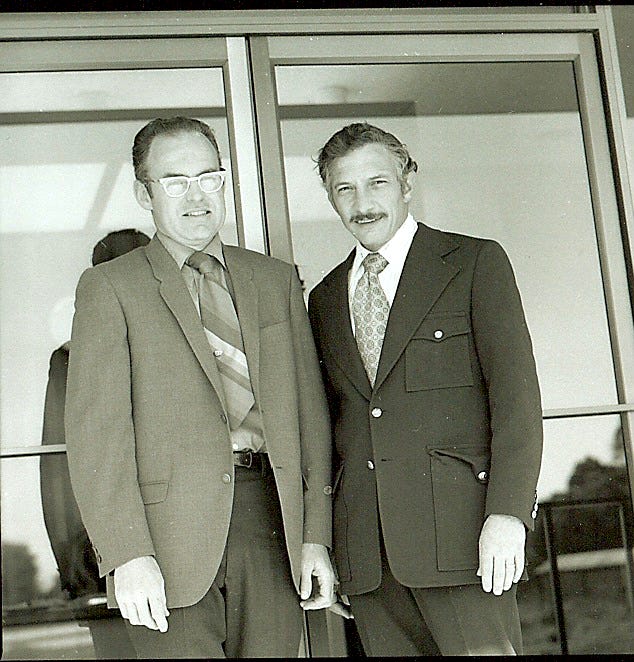
Robert Noyce and Gordon Moore were not first-time founders when they started Intel in 1968. The two had already helped build Fairchild Semiconductor into one of the most important companies in Silicon Valley. Noyce had co-invented the integrated circuit. Moore had articulated Moore’s Law, the principle that the number of transistors on a chip would double roughly every two years, which became the metronome by which the entire industry set its pace. By the late 1960s, they were legends who were frustrated. Fairchild’s parent company kept starving the semiconductor division of the reinvestment it needed. So they left.
They incorporated Intel on July 18, 1968, with $250,000 each of their own money and another $2.5 million raised in a matter of days, mostly on the strength of their names alone. The name came from a portmanteau of “integrated electronics,” though they had to pay $15,000 to buy it from a hotel chain that got there first. They started with a dozen engineers in a conference room and a simple goal: build semiconductor memory that nobody else could. Andy Grove joined almost immediately as their first hire, and the three of them together would go on to form one of the most formidable leadership teams in corporate history.
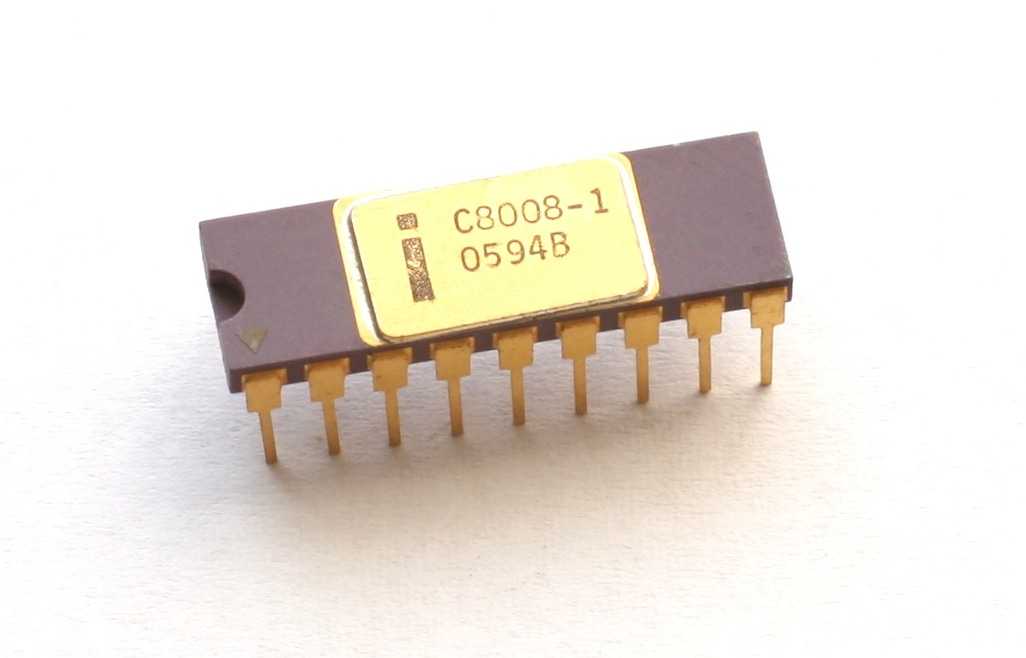
The memory business was good, but the pivot that changed everything came almost by accident. In 1971, Intel released the 4004, the world’s first commercially available microprocessor. It was originally designed to power a Busicom calculator and contained just 2,300 transistors. Intel’s own management was sceptical that it could be sold, but the scepticism was proven wrong. The 4004 was the seed from which the entire modern computing industry grew.
The truly defining moment came in 1981, when IBM chose Intel’s 8088 processor to power its first personal computer. That decision locked in the x86 architecture as the standard for personal computing, a standard that has never been dislodged. Intel didn’t just benefit from the PC boom. It became the PC boom. The “Intel Inside” campaign launched in 1991 turned a semiconductor company into a consumer brand, something almost unheard of in this industry. By 1993, revenue had crossed $10bn. By the end of the decade, it was pushing $34bn. Grove, who eventually became CEO in 1987, built the operational machine that turned brilliant engineering into one of the most dominant businesses in technology history.
The Fall
The decline didn’t happen overnight, and it didn’t have a single cause. It was a slow accumulation of strategic errors, missed markets, and manufacturing failures that took roughly two decades to play out fully.
The first and most consequential mistake came in 2005. Apple approached Intel about manufacturing chips for a new mobile device. Paul Otellini turned them down, deciding the margins and volumes weren’t worth it. Apple went to TSMC instead, and that relationship became the financial foundation that allowed TSMC to invest in leading-edge manufacturing at a scale Intel never matched. Intel missed mobile entirely. And in doing so, it handed TSMC the runway to eventually overtake Intel on process technology.
The manufacturing collapse followed. Intel had built its identity around being the best fab in the world. That identity crumbled at 10nm. The targets were too aggressive, the execution wasn’t there, and while TSMC delivered its 7nm process on schedule and AMD plugged straight into it with its Zen architecture, Intel was stuck on 14nm for years longer than it should have been. AMD sensed the opening and took it. Cloud providers started deploying AMD’s EPYC server chips. Intel’s data centre market share bled out. In 2020, Apple announced it was leaving Intel for its own ARM-based M1 chips. That same year, Intel buried a 7nm delay disclosure in an earnings release. The stock fell sharply.
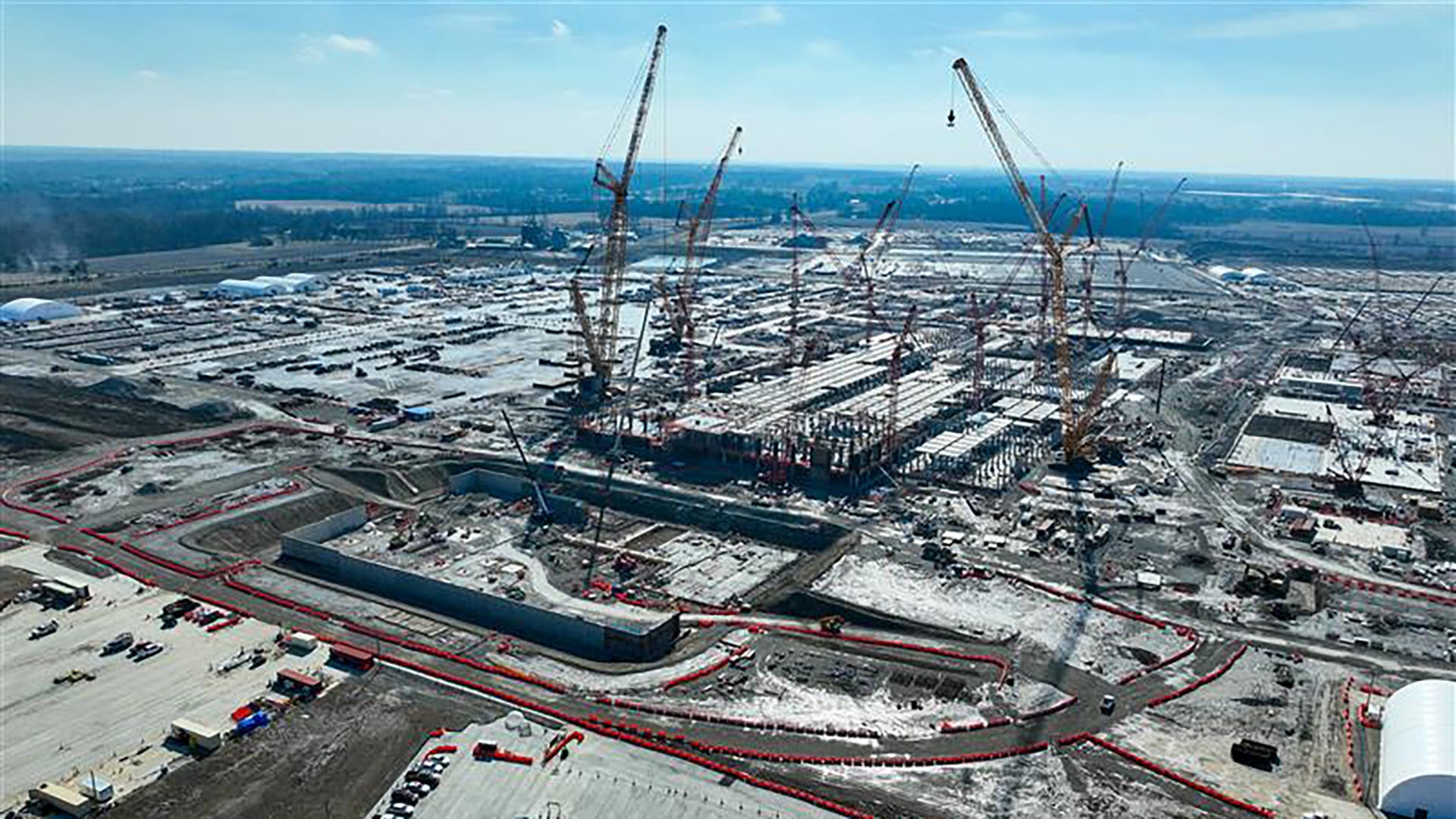
And then the AI boom arrived, and Intel simply wasn’t in the conversation. Nvidia had CUDA. The industry reached for GPUs. Intel had nothing comparable. Its Gaudi AI accelerator existed but generated marginal revenue at a time when Nvidia was doing tens of billions in data centre GPU sales per quarter. Revenue peaked near $79bn in 2021 and then fell for seven consecutive quarters. By early 2025, the stock had fallen to around $18, they had recorded losses exceeding $22bn, and the cuts were visible everywhere. Construction on Ohio One, a $28bn campus in New Albany that was supposed to be Intel’s flagship US manufacturing site and begin production in 2025, was slowed to a crawl with completion pushed back to 2030 at the earliest. And in a sign of just how far things had deteriorated, they sold a 49% stake in Fab 34, their flagship facility in Leixlip, Ireland, to Apollo Global Management for $11.2bn just to shore up the balance sheet. The company that once defined semiconductor manufacturing was selling off pieces of its own factories to survive.
The Comeback
Then Lip-Bu Tan took over as CEO in March 2025, and the tone shifted almost immediately. A semiconductor veteran who had previously run Cadence Design Systems, Tan was the first Intel CEO in a long time who actually understood the business of making chips. He came in and did what needed doing. Jobs were cut, expansion projects were rationalised, and the focus returned to what Intel had always been best at: manufacturing. The 18A process node, which had been Intel’s great hope and frequent source of scepticism from the industry, entered high-volume production at the fab in Chandler, Arizona, in January 2026. That milestone alone was significant. It was the first time in years that Intel had delivered something on time.
The broader political backdrop also started working in Intel’s favour. The current administration has made onshoring semiconductor manufacturing a genuine priority, and Intel is the most obvious domestic beneficiary of that shift. The US government converted its remaining CHIPS Act grants into an $8.9bn equity stake in Intel, making Washington one of Intel’s biggest backers and adding a layer of national security tailwind that no competitor could replicate. This matters beyond the balance sheet. There is a growing view in Washington, one I find hard to argue with, that depending on TSMC for the world’s most advanced chips is a geopolitical risk that needs to be addressed. I personally think a Chinese invasion of Taiwan in the next five years is more plausible than markets are currently pricing. That is a highly speculative view, but if it ever materialised, the consequences for global semiconductor supply would be catastrophic. Intel being a viable alternative to TSMC is not just a business story. It is a strategic imperative.
Nvidia and SoftBank made multibillion-dollar investments alongside Washington’s stake. The balance sheet, which had looked genuinely precarious eighteen months earlier, started to stabilise. Intel ended 2025 with $37.4bn in cash and short-term investments and repaid $3.7bn of debt in Q4 alone. A business that had been selling stakes in its own fabs to survive was now paying down debt. And then in the space of ten days in early April, three announcements landed that changed the narrative entirely (for now).
Intel buys back the Apollo stake
On April 1st, Intel announced it was repurchasing Apollo's 49% stake in Fab 34 for $14.2bn, funded through a mix of cash on hand and around $6.5bn in new debt. That is a 27% premium over what Apollo originally paid. There is an awkward irony here that is worth acknowledging. Intel sold this stake to Apollo in 2024 for $11.2bn because it was desperate for cash, and is now buying it back two years later for $3bn more than it sold it for. That is the cost of having been in survival mode. You make decisions you later have to unwind at a premium. It's not pretty, but it needed to be done. Fab 34 makes Core Ultra and Xeon 6 processors, and with AI inference demand accelerating, Intel cannot afford to share the economics of that facility with anyone. Management expects the deal to be accretive to earnings and positive for the credit profile from 2027 onwards.
The Terafab partnership
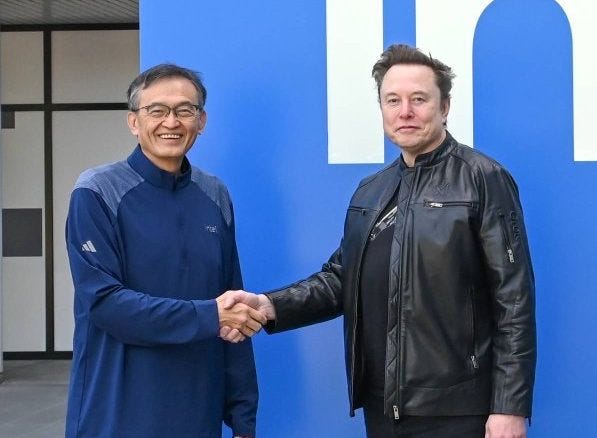
On April 7th, Intel announced it was joining Elon Musk’s Terafab project alongside Tesla, SpaceX and xAI. The ambition is enormous. Terafab is targeting 1 terawatt per year of AI compute, positioning itself as the largest semiconductor production initiative ever attempted. Intel’s role is to design, fabricate and package custom chips for the project. No financial terms have been disclosed and there’s no official timeline, so it’s easy to be sceptical about how much commercial substance sits behind the headline right now. But the symbolic value is significant. The fact that Musk picked Intel to manufacture for Terafab is a meaningful vote of confidence in 18A. A year ago, that probably would’ve been unthinkable.
The Google deal
On April 9th, Intel announced a multiyear partnership with Google under which Google Cloud will continue deploying Intel Xeon processors across AI training, inference, and general-purpose compute workloads, with both of them also expanding co-development of custom infrastructure processing units (IPUs). No financial terms were disclosed. What makes this meaningful is that Google has simultaneously been building its own custom silicon. The fact that it’s still committing to multiple generations of Intel Xeon tells you x86 isn’t going anywhere in the data centre, and that Intel’s CPU roadmap is credible enough for one of the world’s largest cloud providers to stake its infrastructure on for years ahead.
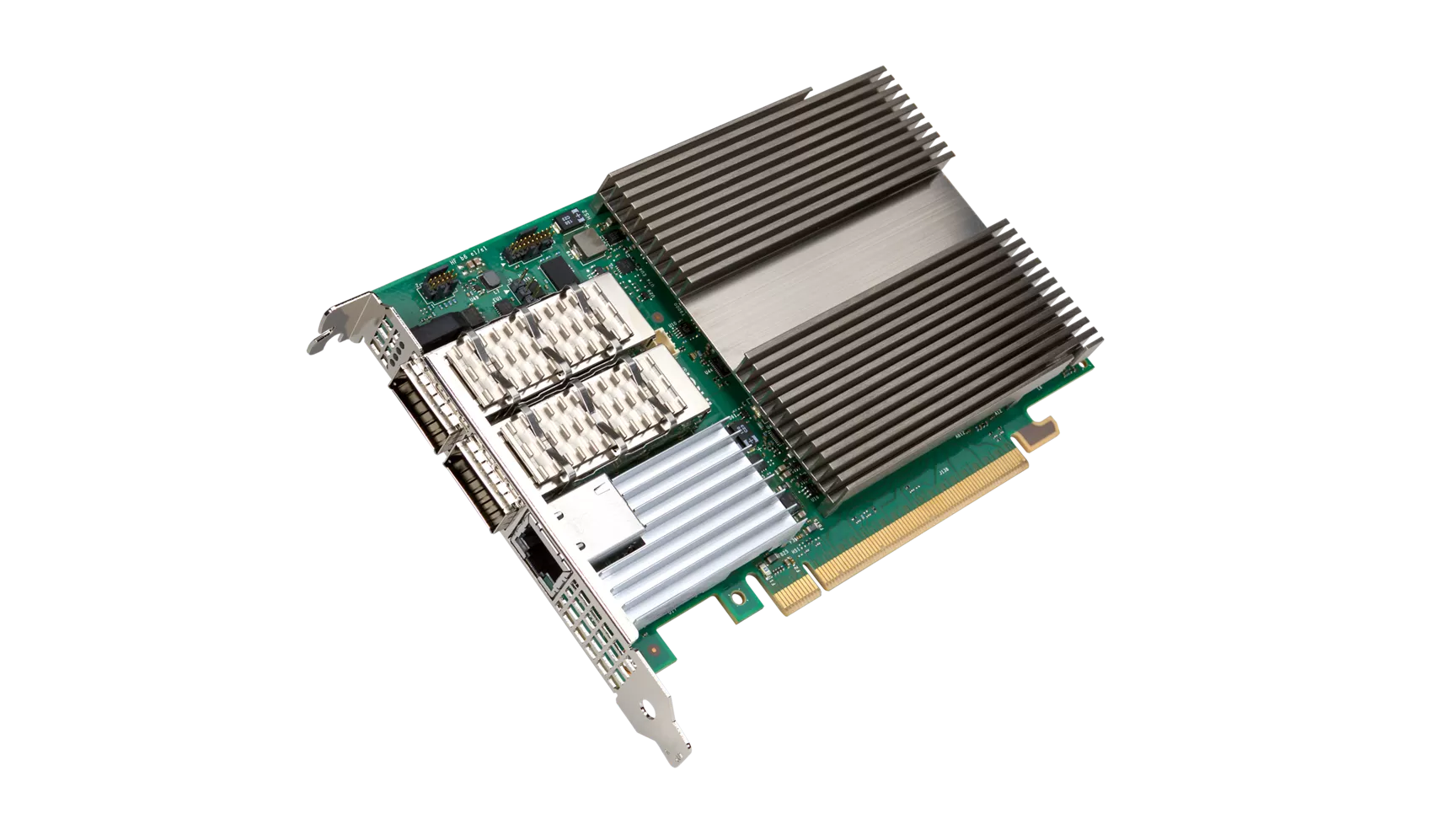
If you’re keeping track of the ever-expanding universe of PUs, welcome to the IPU. The semiconductor industry has developed a habit of inventing a new processing unit every few years, and the infrastructure processing unit is the latest addition to the family. Where a CPU handles general compute, and a GPU handles parallel processing, an IPU is designed to take over the unglamorous but essential work that would otherwise eat into CPU capacity: networking, storage management, security functions, and packet processing. By offloading those tasks onto a dedicated chip, the CPU is freed up for higher-value work, and data centres become meaningfully more efficient at scale. For hyperscalers running millions of servers, that efficiency gain is not marginal; it compounds.
Price Action
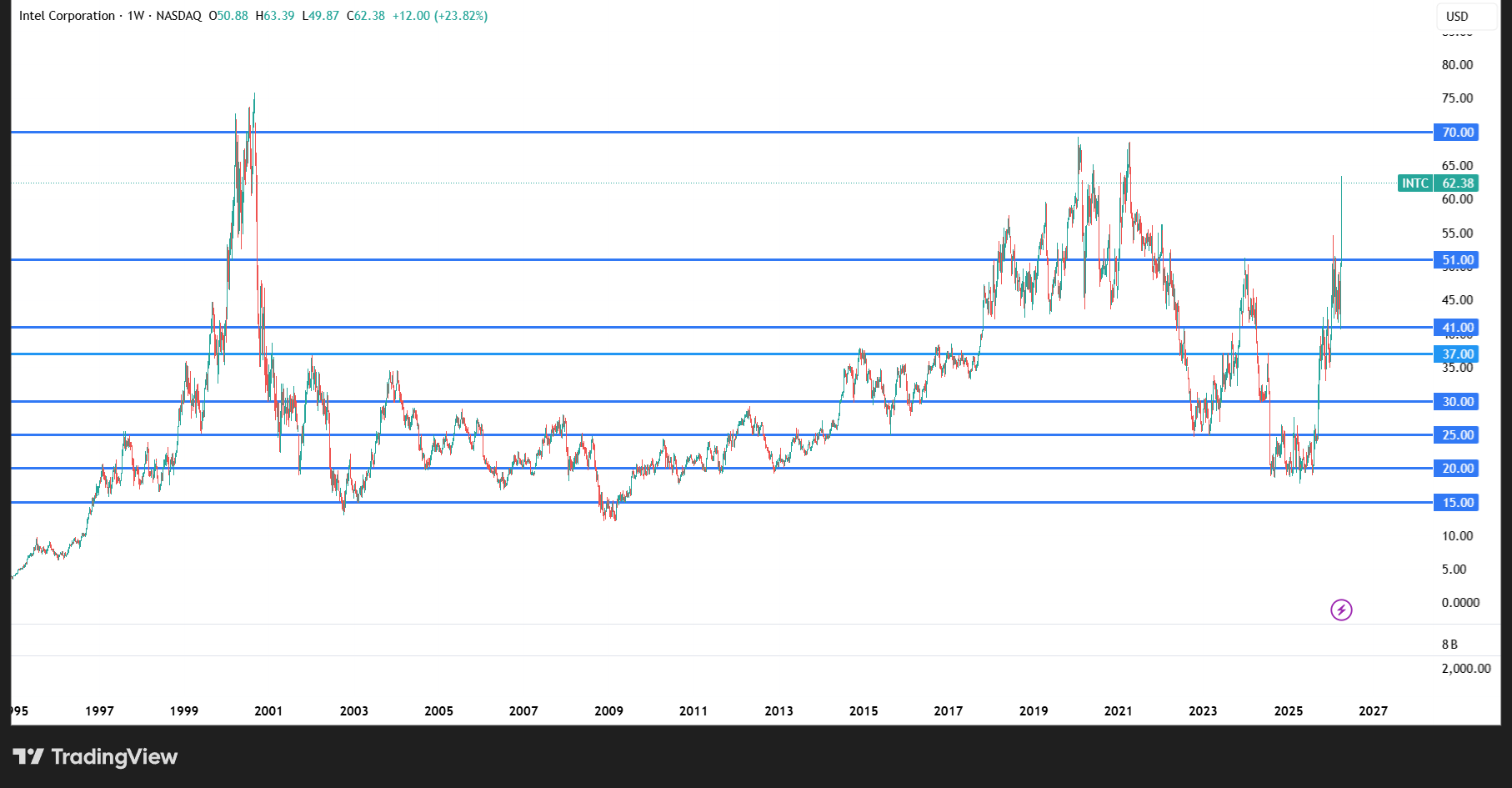
Following these recent developments, INTC 0.00%↑ is up ~22% in the last week. To think that INTC 0.00%↑ was trading at $20 last September (2025) is crazy! It’s now nearing all-time high territory. I don’t like to add on huge moves like these, but as a shareholder, I’m pleased to see the jump! Of course, the investment is long-term, but it’s unrealised PnL; however, seeing a positive trajectory reassures the investment thesis.
Conclusion
Intel's story is not over, and the bear case hasn't disappeared entirely. Execution on 18A yields still needs to hold up over time, and Q1 2026 earnings on April 23rd will be the next real test. But the narrative has definitively shifted. A business that was selling pieces of itself to stay alive eighteen months ago is now buying them back, landing partnerships with Google, and manufacturing chips for the most ambitious AI compute project ever attempted. Whether you're a shareholder or just watching from the sidelines, that is a remarkable turnaround in a very short space of time. I'll be watching the April 23rd print closely.
As always, thank you for reading. If you found this useful, please consider sharing it with someone who might enjoy it.
Disclaimer: This article is for informational purposes only and should not be considered financial or investment advice. The views expressed are my own and based on publicly available information, market trends, and personal analysis. I own Intel shares, which may change at any time. Readers should conduct their own research and consult a financial professional before making any investment decisions.